
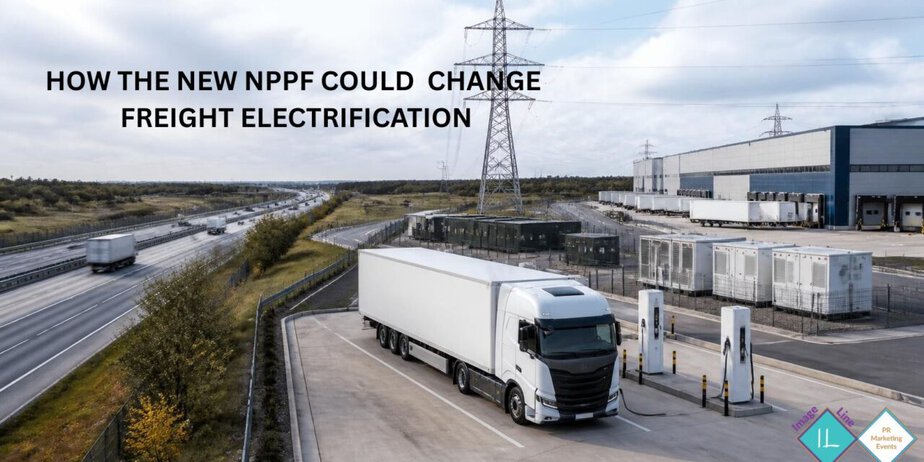
New national planning policies for freight, grid infrastructure and low-carbon energy could have important consequences for electric HGV depots, charging hubs, battery storage and shore power. Image Line examines what has changed and what it could mean for VEV, NatPower UK, and NatPower Marine.
Freight has not always sat comfortably within the planning system. The economy depends on warehouses, depots, ports and distribution centres. However, planning policy has tended to focus heavily on managing their impacts rather than recognising the particular infrastructure needs for freight to function.
The new National Planning Policy Framework (NPPF), published on 17 August 2026, marks a significant change.
For the first time since the Framework was introduced in 2012, freight and logistics has a standalone national decision-making policy. Policy E3 recognises some of the practical realities of the sector, including access to transport networks, night-time operations, secure vehicle parking and EV charging.
Important though E3 is, it is only part of the story. Read alongside the new policies covering commercial development, electricity networks and low-carbon energy, the Framework begins to address one of the biggest practical questions facing freight decarbonisation: where is all the infrastructure needed to electrify transport actually going to go?
That question matters to several of the markets in which Image Line’s clients operate.
VEV: planning for the electric HGV depot
It is easy to talk about fleet electrification as a vehicle transition. At depot level, the reality is rather different.
Replacing diesel HGVs with electric vehicles can fundamentally change a site’s energy requirements. Chargers are only the most visible part of it. Depending on the fleet and available grid capacity, an operator may also need a new or reinforced connection, transformers, substations, battery energy storage, solar generation and an energy-management system capable of making the whole thing work.
VEV is already dealing with those challenges in live commercial fleets.
Its work with Maritime Transport has delivered 5MW of charging capacity across three logistics depots to support 36 electric trucks. At Dawsongroup’s Milton Keynes site, VEV combined 34 EV chargers with 262kWp of solar generation and 300kWh of battery storage, creating a clean-energy microgrid to help address power constraints.
Projects such as these show why the planning changes matter.
Policy E2 says substantial weight should be given to the economic benefits of commercial development that allows businesses to invest, expand or adapt, including freight and logistics improvements. E3 explicitly recognises EV charging in the context of freight development, while W3 strengthens the national policy position for renewable and low-carbon energy development and electricity network infrastructure.
For an existing depot electrification project involving charging, battery storage and significant electrical works, there is now a much clearer relationship between national freight policy and national energy policy.
There is another change in E2 which may prove even more interesting.
When considering unmet need, the Framework recognises that the particular importance of a location can arise from the availability of electricity network infrastructure providing an adequate grid connection.
For electric HGV infrastructure, that could have considerable practical consequences.
The conventional approach has generally been to find an appropriate logistics or employment site and then establish whether enough electricity can be delivered to it. For a large electric fleet, that sequence can become expensive, slow or simply unworkable.
The new policy provides a stronger basis for considering electricity availability much earlier in the site selection process.
For businesses operating in VEV’s market, that could support a different conversation around shared eHGV charging hubs and other high-capacity charging infrastructure. Where do HGV movements, motorway access, suitable land and available electricity capacity already come together?
The answer may not always be where the conventional planning system would historically have expected a major charging facility to go.
NatPower UK: storage and the infrastructure behind the grid
If freight policies are important to fleet electrification, Policy W3 deserves equal attention from the energy sector.
It requires substantial weight to be given to the benefits of renewable and low-carbon energy development and electricity network infrastructure, including their contribution to energy security, economic development and net zero.
Just as importantly, applicants should not be required to demonstrate the need for renewable or low-carbon energy development and electricity network infrastructure.
Battery energy storage is expressly included within the NPPF’s definition of low-carbon technologies.
For developers such as NatPower UK, which is developing large-scale battery storage and electricity infrastructure, this provides projects with a stronger, clearer national policy backdrop.
That does not mean a BESS proposal will automatically receive planning permission. There are legitimate questions around site selection, landscape, ecology, highways, noise, fire safety and other local impacts, and those still have to be addressed properly.
What has changed is the starting point.
A planning application should not have to establish from scratch whether the country needs renewable or low-carbon energy infrastructure or electricity network infrastructure before the merits of the particular development can be considered.
That distinction matters as Britain’s electricity system changes.
The transition to net zero is not simply about building more renewable generation. Electricity has to be stored, moved and delivered to rapidly growing sources of demand, including transport.
Freight electrification therefore creates an interesting relationship between companies operating on different sides of the energy equation. Businesses such as VEV are dealing with substantial new demand at depots and charging sites, while businesses such as NatPower UK are developing storage and network infrastructure to support a more flexible electricity system.
Planning policy is beginning to reflect the fact that those worlds are increasingly connected.
NatPower Marine: when a port becomes a major electricity user
That connection becomes particularly obvious at ports.
Ports are included within the NPPF’s definition of freight and logistics, giving them a direct relationship with the new E3 policy. At the same time, the decarbonisation of shipping is creating potentially enormous new electricity requirements on the waterfront.
NatPower Marine is developing shore-power and clean-energy infrastructure for ports, including projects designed to allow commercial vessels to connect to electricity while alongside rather than relying on their onboard auxiliary engines.
The concept sounds straightforward. The electrical infrastructure behind it often isn’t.
Supplying large commercial vessels can require substantial grid connections, substations, battery storage and sophisticated power-management infrastructure. All of that has to be installed within ports which are already complex, space-constrained and operational around the clock.
A shore-power development can therefore sit at the intersection of several parts of the new Framework. It is infrastructure serving freight and port operations, but it may also involve precisely the electricity network and low-carbon infrastructure covered by W3.
That is a more useful way of thinking about port electrification.
Shore power should not simply be regarded as an environmental addition to a port. As maritime decarbonisation gathers pace, access to large quantities of electricity is likely to become part of the infrastructure required to operate a competitive modern freight gateway.
For NatPower Marine and the ports with which it works, the fact that national planning policy is beginning to join those considerations together is significant.
A different way of thinking about location
There is a common theme running through all three markets.
Electricity is beginning to influence the geography of freight.
For much of the logistics property market, the starting point for development has traditionally been land: identify a suitable site, secure planning and then deal with utilities and grid requirements.
Power-intensive transport potentially changes that calculation.
An electric HGV charging hub needs to be where trucks can realistically use it, but it also needs access to enough electricity. A BESS project has an obvious relationship with the electricity network. Shore power has to be delivered at the berth, regardless of whether that happens to be a convenient place to provide very large quantities of power.
The recognition given to grid availability in the new Framework therefore matters beyond an individual planning application. It gives developers and investors a reason to consider land, transport, and electricity together from the earliest stages of a project.
That does not mean grid availability trumps everything else. It doesn’t. Nor does the new NPPF remove environmental protections or the need to consider neighbouring communities. Green Belt proposals remain subject to the Framework’s specific Green Belt policies.
There is also an important distinction between planning and delivery. Planning permission does not guarantee a grid connection, and securing the necessary electricity capacity can remain difficult and expensive.
Property creates another complication. Many fleet operators lease their depots rather than own them, so significant investment in charging, substations or other fixed infrastructure may require agreement with landlords and consideration of lease length and asset ownership.
Those issues will not disappear because national planning policy has changed.
What has changed is the extent to which the planning system recognises the infrastructure problem in the first place.
The opportunity is bigger than individual projects
There is a temptation to view these policies principally in terms of whether they make a particular depot, battery, or substation easier to consent to.
The longer-term consequence could be more interesting.
If grid availability can legitimately influence where power-intensive freight development is located, developers can begin looking systematically for places where electricity capacity and freight activity already coincide.
For road freight, that means examining the relationship between grid capacity, motorway junctions, existing logistics clusters, HGV flows and suitable land.
At ports, it means thinking much earlier about future electricity requirements when planning berth development and other infrastructure.
For energy developers, it means recognising transport electrification as an increasingly important source of demand and considering how storage and network infrastructure can support it.
That is a much more joined-up approach than treating a truck, charger, depot, battery, substation and grid connection as six separate problems.
The new NPPF does not solve freight electrification. Technology, vehicle economics, grid capacity, land, property ownership and investment will continue to determine how quickly the transition happens.
But planning matters because virtually every piece of physical infrastructure behind that transition eventually has to be built somewhere.
For years, freight businesses have been trying to fit electrification into a planning system largely created before anybody seriously contemplated thousands of electric HGVs drawing megawatts of power from logistics depots.
The new Framework begins to catch up with that reality.
For VEV, NatPower UK, NatPower Marine and the wider freight and energy sectors, the important question now is what can be done with it.


